
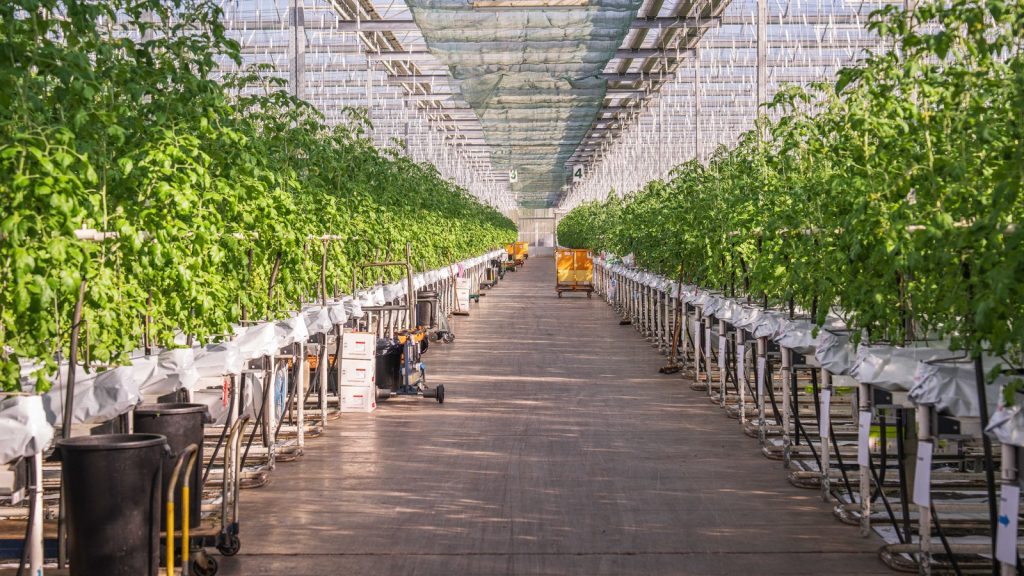
Looye Kwekers’s greenhouse in Burgerveen, the Netherlands, turns four liters of water into a kilogram of tomatoes, against more than 200 liters in the global field-grown average. Inside, tomato plants climb roughly a foot of string (about 30 centimeters) every week, lowered gradually on scissor lifts as they grow. Between the rows, wooden boxes hum with bumblebees, about 800 to a box, that the greenhouse depends on for something a fully enclosed building can’t do on its own: pollinate. Cultivation manager Stefan Lazar puts it plainly: “You cannot do it without them. So they are probably one of the most important tools that we have in our glasshouse.”
The efficiency case is in the water, not the robots
That ratio is the foundation of Dutch greenhouse tomato growing, and Looye’s greenhouse is where it can be seen at its clearest, plant by plant, week by week. It is reached through water recycling rather than any single dramatic invention: condensation and rainwater are collected, sanitized, and returned to the plants in a closed loop instead of draining away or evaporating in open fields. On the same basis, Dutch greenhouse tomato production yields roughly twelve times what an average tomato farm produces globally, on the same amount of land. A few kilometers away, a pepper grower applied the same logic to heat by drilling its own geothermal well.
What Looye adds on top of the baseline
Founded in 1946, when Jacobus Looije started a vegetable farm in the Westland region, the company now runs two production sites, its original Westland base and the newer Burgerveen greenhouse opened in 2011. In 2005, the company stumbled on a cherry vine tomato variety it later launched commercially in 2009 as “Honeytomatoes,” a glossy red, honey-sweet Piccolo tomato that became one of its signature products. Ripe tomatoes are still harvested by hand, then processed, packaged, and placed in cold storage within 24 hours, a timeline the company treats as central to freshness rather than a bottleneck to automate away.
Precision, not scale, as the actual lever
What Looye’s greenhouse demonstrates is not a single breakthrough technology but a stack of small, deliberate choices: a closed water loop, a managed bee population instead of hand-pollination or none at all, and a strict harvest-to-storage window. None of those pieces alone would explain the yield difference. Together, inside one greenhouse in Burgerveen, they add up to a production system built around precision rather than raw size, the same bet a shrimp farm in Brittany makes with a closed water loop of its own. It is a harder thing to photograph than a factory floor, but no less a piece of industrial design.
Photo : NC Farm Bureau Mark / Pexels