
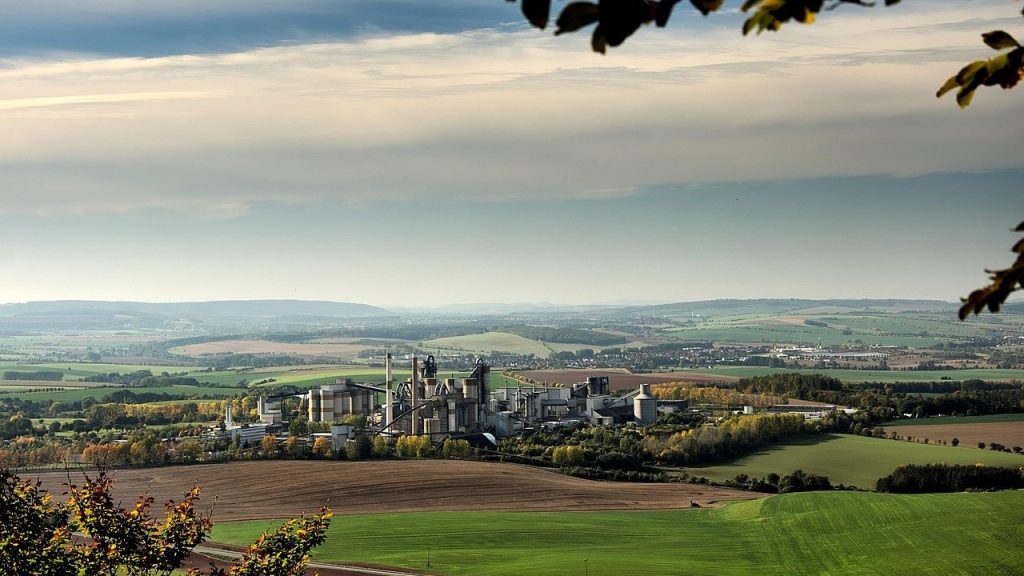
In Ste. Genevieve, Missouri, a town of fewer than 5,000 people on the west bank of the Mississippi River, a Mississippi Lime Company kiln has been turning limestone into high-calcium lime since the 1920s. Next to that working plant sits an empty stretch of ground. On October 22, 2026, Fortera and MLC announced that this is where they intend to build the first commercial plant to turn a lime kiln’s waste CO2 directly into cement.
Ste. Genevieve is Missouri’s oldest town, founded by French colonists in the 1730s as the first organized European settlement west of the Mississippi. What it has never had is a cement plant. The one Fortera wants to build there would run on a gas the lime plant next door already produces and currently releases, instead of mining new limestone and burning fuel to make clinker the conventional way.
A kiln that already runs, and a gas it already produces
Making high-calcium lime means heating crushed limestone until it releases carbon dioxide, a step called calcination. MLC has been doing this at Ste. Genevieve for close to a century, and the site is, in Fortera CEO Ryan Gilliam’s words, “the largest lime operation in the Americas.” That scale is exactly why Fortera picked it: a bigger kiln means a bigger, steadier stream of CO2 to work with.
Fortera’s technology, called ReCarb, is built to capture that CO2 before it reaches the air and feed it into a chemical reaction that produces ReAct, a cement that is nearly 50% captured carbon dioxide by weight. MLC CEO Paul Hogan frames the appeal in plain terms: the process “not only reduces the amount of carbon we release, it also turns it into a valuable product.” Fortera says the finished cement cuts emissions by 70% compared with ordinary portland cement, a figure the company reports itself rather than one verified by an outside auditor.
Why a 300,000-ton plant has to start as a 15,000-ton one
Fortera already runs a smaller version of this process in Redding, California, producing about 15,000 tons of ReAct cement a year. That plant has supplied real projects: municipal work in Berkeley and Santa Cruz, California, work for the California Department of Transportation, and an academic building at Simpson University in Redding, where crews were pouring Fortera’s cement in early 2025. The Ste. Genevieve plant, if it gets built, would target 300,000 tons a year, roughly twenty times Redding’s output. A standard cement plant produces closer to a million tons a year, so even at that scale Ste. Genevieve would still be a mid-sized newcomer in an industry that runs on much bigger kilns.
Gilliam calls the jump from Redding to Ste. Genevieve “the moment we go from showing the technology works to showing it works at scale.” Cement is a hard material to decarbonize: production accounts for roughly 8% of the world’s greenhouse gas emissions, and almost none of the roughly 4 billion tons used globally each year comes from a low-carbon process. Fortera’s bet is that a commercial-scale plant, not another pilot, is what finally tests whether ReAct can be built and sold at a price that construction buyers will actually pay.
A certificate for cement that does not exist yet
A plant that exists only on paper still needs financing, and that is where Meta enters the story. Meta is not buying cement from Fortera. It has signed a multi-year deal to buy environmental attribute certificates, tradable credits tied to roughly 200,000 tons of the cement the Ste. Genevieve plant would eventually produce. Microsoft has also invested directly in Fortera and plans to buy its own certificates. A pre-committed buyer willing to pay for output years before a single ton ships is what turns a construction estimate into a bankable project, which is precisely the role Meta’s deal is designed to play.
Devon Lake, Meta’s head of net-zero strategy, puts it this way: “A multiyear commitment is what gets a cement plant financed. Our agreement helps Fortera move the Ste. Genevieve plant from plan to production, which means construction jobs and long-term manufacturing jobs in Missouri, and low-carbon cement available to builders well beyond Meta.” For a company that spends heavily on the concrete shell of every new data center, locking in lower-carbon cement at scale, long before ground is broken, is cheaper than retrofitting a supply chain once demand catches up.
Gilliam describes the financing of a plant like this as a row of dominoes that each need to fall before construction can start: corporate commitments, project debt, and anchor customers for the cement itself. “Meta is really one of those dominoes,” he says. On that last point, Ozinga, a Midwest building materials supplier, has already agreed to purchase and distribute cement from the Ste. Genevieve plant once it is running.
What happens next in Ste. Genevieve
Fortera estimates the plant will cost around $150 million to build and targets 2028 for the start of operations, both figures the company describes as current estimates rather than signed, final numbers. Construction has not started. What exists today is a site selection, a certificate deal, and a lime kiln next door that will keep doing what it has done since the 1920s regardless of what gets built beside it.
If Ste. Genevieve comes online as planned, it will not solve the cement industry’s carbon problem on its own. One 300,000-ton plant is a fraction of the roughly 4 billion tons of cement poured every year. What it would do is give an industry still short on commercial-scale, low-carbon options a working example to point to, built next to a lime plant that was already there, financed in part by a buyer who will never see a bag of the cement it paid for.
Photo: HansLinde, Pixabay Content License.
Photo: caropat, Pixabay Content License.