
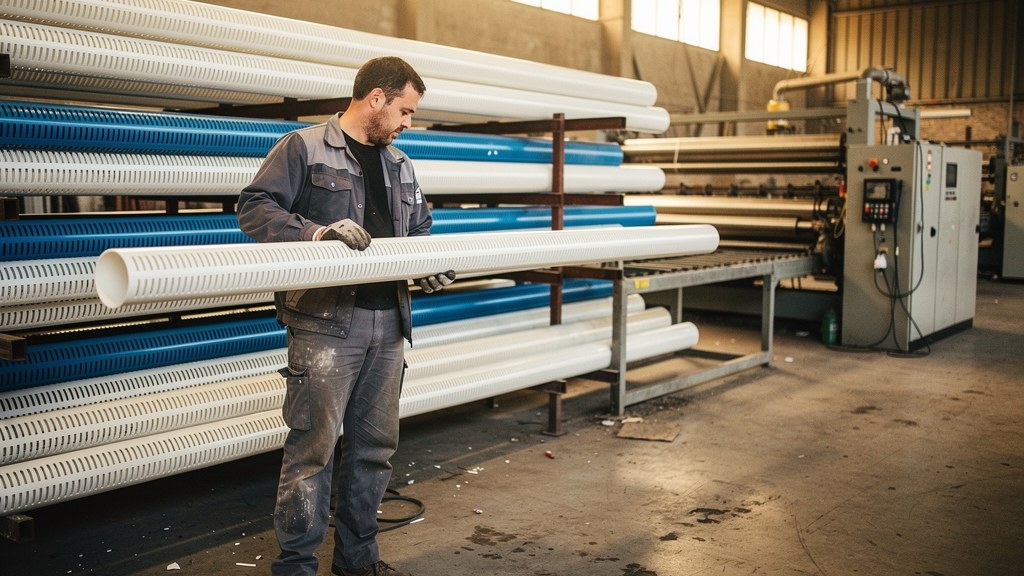
Promafor Sovema runs a PVC pipe plant in Vauvert, a small town in the Gard department of southern France, producing roughly 800 tonnes of well casing and screen a year. A slotting head cuts thousands of narrow openings down each length, one after another, turning plain tube into well screen, work destined for two jobs that sit closer together than they look: water wells, where reliable access to a resource that is not infinite is the whole point, and geothermal boreholes, which draw heat instead of water but need the same intact casing to do it. It is, in a literal sense, the same craft serving two transitions at once.
What turns a pipe into a well screen
A borehole is only as good as the pipe that lines it. Plain casing keeps the hole from collapsing; a screen, called a “crépine” in French drilling terminology, is the section with slots cut into it that lets groundwater in while keeping sediment out. Promafor Sovema cuts these slots to standard widths of 0.5 and 1 millimeters, or custom on request, on pipe certified under France’s A.C.S. sanitary standard when the end use is drinking water. The company also produces threaded and glued connection systems and works high-density polyethylene (PEHD) alongside standard PVC, since a water well, a monitoring piezometer and a geothermal borehole rarely call for exactly the same pipe. That range is what lets a driller specify a complete string, casing, screen and joints, from a single catalogue instead of assembling it from several suppliers.
Where geothermal fits in a water-well catalogue
Geothermal has become a standing line in the Promafor Sovema catalogue alongside the water-well business the company was built on: PEHD double-U ground loop probes for shallow geothermal installations, thermal grout, glycol and the collectors that connect a borehole field back to a heat pump. The casing and screen around those probes come from the same slotting line in Vauvert, so a driller moving from water wells to heat pump loops does not have to change supplier. It is the same underlying logic as the greenhouse in the Netherlands that drilled its own geothermal well instead of burning gas: before a heat pump can draw anything out of the ground, something has to go in the ground first and stay intact for decades.
Forty years, four depots, and a lot of stock
Promafor Sovema has been manufacturing PVC pipe for drilling since 1983. The company now carries around 225,000 references across four regional depots, in Lyon, Nîmes, Nantes and Paris, on top of the Vauvert plant itself, a setup built around one constraint every driller knows: once a hole is open, it cannot wait. A screen of the right diameter and slot width has to be on the truck the same day, not on order. Holding that depth of stock in four regions is a deliberate choice, and it is the part of the business a client never sees unless it fails.
That position, upstream of the visible part of an energy or water project, is one the plant shares with the recycled rare-earth magnets coming out of a site near Grenoble: components that make the rest of the installation possible, whether or not anyone photographs them.
None of the pipe leaving Vauvert looks different depending on what the finished borehole will eventually draw out of the ground: water, monitoring data, or heat. What changes is only what happens once Promafor Sovema’s casing and screen are underground, doing the job each well was built for, and doing it quietly for as long as the well is in use.