
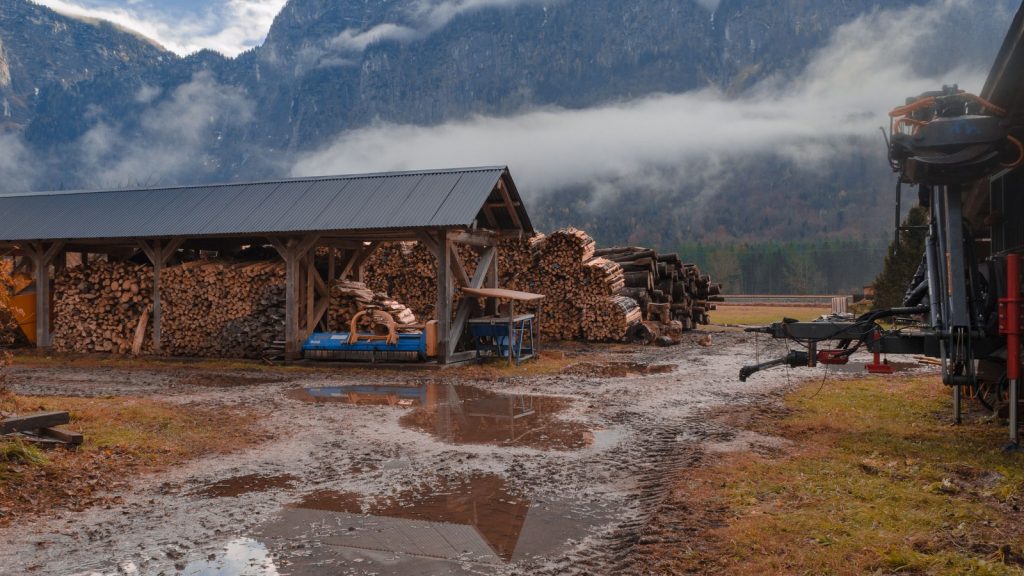
WUN-Bioenergie GmbH runs a biomass plant in the Holenbrunn district outside Wunsiedel, a small town in the Fichtelgebirge forest region of Bavaria, that turns local forest residue into electricity, then uses the leftover heat to dry and press sawdust into roughly 38,000 tonnes of wood pellets a year. Treetops and offcuts from local forestry and landscape-maintenance work arrive by the truckload before ever leaving the region; an ORC turbine converts that material into electricity first, and the heat left over feeds the pellet line. Part of those pellets heat homes and businesses through district heating networks in three nearby villages, the rest is sold across northern Bavaria, Thuringia and Saxony. Nothing about the loop is exotic: it works because the forest, the plant, and the surrounding villages sit close enough together to make hauling waste elsewhere pointless.
Two loops, not one
The operator is WUN-Bioenergie GmbH, a joint venture whose shareholders include the municipal utility SWW Stadtwerke Wunsiedel, two other regional companies, and two local forestry associations. According to the town of Wunsiedel’s own figures on the plant, raw biomass, mainly treetops and material from forestry and landscape-maintenance work, feeds an ORC turbine, a technology built to pull usable electricity out of lower-temperature heat sources like burning wood, rather than the high-pressure steam turbines used at conventional power plants. That first step produces electricity.
The heat left over from generating that electricity does not go to waste. It dries sawdust, which is then pressed into pellets. The plant produces roughly 38,000 tonnes of wood pellets a year, according to the profile of the town published by Germany’s renewable energy agency: part of it fires satellite heating plants in the nearby villages of Schönbrunn, Breitenbrunn and Neusorg, which feed local heat networks and generate some electricity of their own, and the rest is delivered to pellet markets in northern Bavaria, Thuringia and Saxony. The Schönbrunn satellite plant has run since 2012, the same year four neighboring towns, including Wunsiedel, jointly adopted the climate protection plan that the whole strategy grew out of. One loop turns waste wood into electricity. A second loop, running on the first one’s leftover heat, turns more of the same wood into a fuel that heats three villages.
The utility behind the utility
SWW Stadtwerke Wunsiedel, the municipal energy company that anchors the project, is run by Marco Krasser, appointed its managing director in 2001. Under his direction, the town’s broader energy strategy, publicly branded the Wunsiedler Weg, has expanded well beyond biomass: solar and wind generation, battery storage, hydrogen production, and participation in the intraday electricity market. Excess renewable output gets stored in batteries and converted to hydrogen rather than curtailed.
The wood-pellet loop itself is run at arm’s length from Stadtwerke Wunsiedel, through the separate WUN-Bioenergie joint venture, with the forestry associations that supply the wood sitting on the shareholder side. That structure is part of why the model has held for more than a decade: the people who bring the raw material in have a stake in what comes out.
What the model actually requires
None of this works without a forestry and landscape-maintenance industry already producing wood residue at scale nearby. Wunsiedel didn’t invent a wood-waste supply chain: it built an energy system on top of one that already existed. That dependency is the precondition of the Wunsiedel case, not a flaw in the design. A region without an established timber industry could not simply copy the plant and expect the same loop to close.
What travels well is the logic, not the specific machinery: pair an energy operator with a local material stream that already flows past its door, and route the waste heat back into the process before it escapes anywhere else. Wunsiedel’s forests happened to make that pairing obvious. Somewhere else, the equivalent local stream would look completely different.
Photo : Julia Sakelli / Pexels