
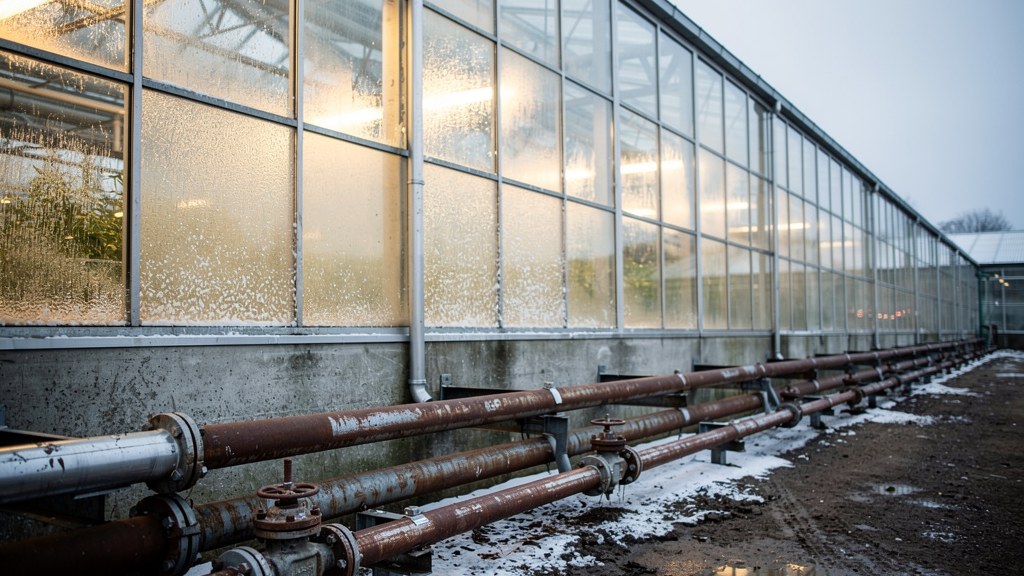
When Russia’s invasion of Ukraine sent European gas prices spiking, Dutch pepper grower VD Holland and a handful of regional growers put $46 million (roughly 42 million euros) into a geothermal well, drilling for heat instead of burning imported gas to warm their greenhouses. The investment cut VD Holland’s gas consumption in half.
A greenhouse that stopped depending on someone else’s gas
Dutch greenhouse agriculture runs on heat, and for decades that heat came overwhelmingly from natural gas, much of it Russian before 2022. The same closed-loop thinking that lets a nearby tomato grower turn four liters of water into a kilogram of tomatoes now applies to heat. VD Holland, co-owned and directed by Arnaud van Dijk, produces around 85 million peppers a year through hydroponic growing, all of it dependent on keeping its greenhouses at a stable temperature through a Dutch winter. Geothermal drilling doesn’t eliminate that dependency so much as relocate it, from a pipeline that can be cut off by a war on another continent to a well the company controls on its own land.
The greenhouse is not VD Holland’s only automated system. The company has used automated guided carts, wire-tracked and unmanned, to move harvested peppers to processing since 2007, well before the current wave of warehouse robotics became common. At the sorting stage, AI-powered cameras photograph each pepper and compare it against a database of what an ideal one looks like, grading by size, weight, shape, and color faster than a human sorting line could. Van Dijk is now working on a further step: training computer vision systems to read sticky trap cards used for pest monitoring, so infestations get flagged and treated with biological controls faster than a manual check would catch them.
A harder efficiency problem, next door
Not every efficiency gain in Dutch agriculture comes as quickly. At Wageningen University‘s Dairy Campus, researchers are testing an ammonia-reduction device aimed at a different, messier problem: manure and urine mixing on a barn floor, releasing ammonia that has to be regulated. One version tested at the campus, described by staff there, costs in the tens of thousands of dollars per unit (several tens of thousands of euros), and a working farm would likely need more than one to cover a full barn. That price is a large ask for an average dairy operation, which is why the device is still on a research campus rather than in barns: a promising technology also has to clear the cost threshold that gets it installed on a working farm.
Two answers to the same underlying question
VD Holland and Wageningen’s dairy researchers are answering versions of the same question: how do you cut the resource cost, energy or emissions, of producing food without cutting the food. It is the question a shrimp farm near Rennes answers with water rather than heat. VD Holland’s answer paid for itself well enough that the company keeps expanding automation around it. Wageningen’s is still a device being refined on a research campus, waiting for a price point that makes sense outside a lab. Two different timelines, on the same road.