
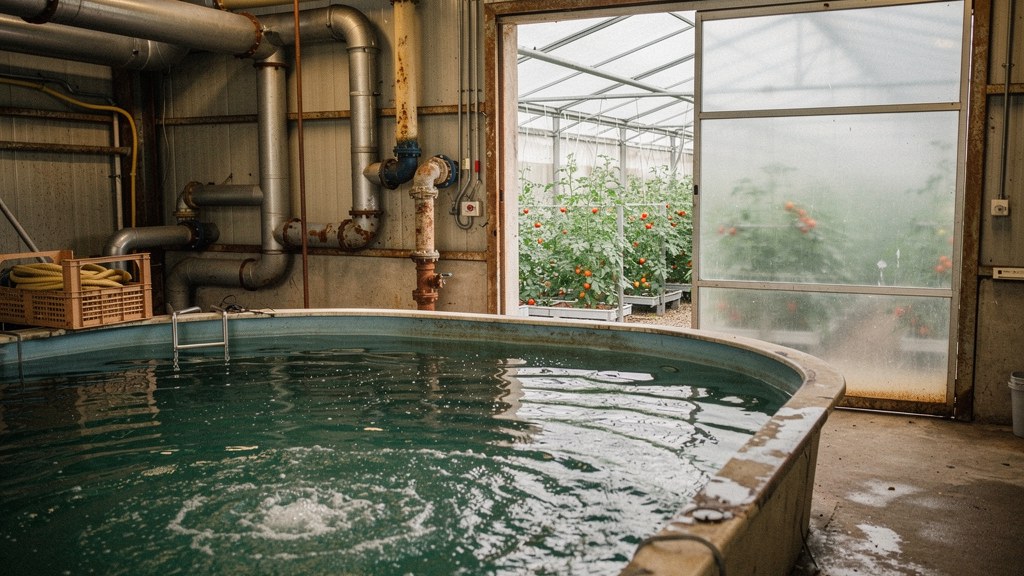
Agriloops opened its first commercial plant, Mangrove #1, in Bréal-sous-Montfort near Rennes in 2025: a shrimp pool feeding a greenhouse next door, its water reused as fertilizer once thick with the waste the shrimp produce. The site pairs 2,000 square meters of aquaculture building with 5,000 square meters of greenhouse, the result of nearly a decade of work getting the idea from lab bench to one working plant.
Why bother growing shrimp inland at all
France eats roughly 100,000 to 120,000 tonnes of shrimp a year, and almost all of it is imported, mostly from Southeast Asia, Central America, and Madagascar. Agriloops’ pitch is a domestic, antibiotic-free alternative grown far from any coastline. Founder and CEO Jérémie Cognard says the company is the first in the world to run saltwater aquaponics at this scale, pairing shrimp aquaculture with vegetable growing in a closed loop that needs no proximity to the ocean at all, just water chemistry engineered to hold salt. The company says the loop saves up to 90 percent of the water a comparable separate shrimp farm and greenhouse would use, water recycling being already the rule in Dutch greenhouses that grow a kilogram of tomatoes on four liters of water, and the site is designed to produce over 100 tonnes a year of shrimp and produce combined.
Agriloops was founded in 2016 by Cognard and co-founder Romain Vandame, both agronomy engineers, one focused on aquaculture and the other on plant production. The company built a 100-square-meter proof-of-concept funded by a 2019 crowdfunding round on the platform Sowefund, then spent years finding the right site for a full-scale plant, inspecting around twenty candidate locations before settling on the current one outside Rennes.
The money behind the move from lab to factory
Agriloops closed a total funding round of roughly 13 million euros in 2024 to build Mangrove #1, backed by BNP Paribas Développement, OGHI, SPV Aqua Invest, the Breton regional fund Breizh Up, impact investors Transitions First and Good Only Ventures, and the Sustainable Ocean Alliance. An earlier Series A tranche of about 5.5 million euros, also from BNP Paribas Développement alongside Sowefund, closed in February 2024, an intermediate step within that same fundraising push rather than a separate round. Public support layered on top of the private capital: Bpifrance’s Première Usine program, France’s post-pandemic recovery plan, and ADEME, the state environment and energy agency, which funded two biomass boilers that source wood within a 50-kilometer radius, drawing on the surrounding Breton countryside rather than shipped fuel.
The loop doesn’t stop at water
That biomass heating is easy to miss next to the more obvious shrimp-to-greenhouse water loop, but it closes a second circuit: the plant heats itself on locally sourced wood rather than importing fuel, a choice close to the one made by a Dutch pepper grower who drilled for geothermal heat rather than keep buying gas, and the same logic of proximity that shapes where the shrimp waste goes and where the vegetables grow. The company has also floated a future product, a cherry tomato enriched with extra sugar and vitamin C using nutrients drawn from the shrimp water, though that remains a product still in development rather than something on shelves today.
Mangrove #1 employed 15 to 20 people when it opened. Hiring engineers and technicians came easily, Cognard has said, given the novelty of the project. Finding seasonal agricultural laborers proved harder, a reminder that a genuinely new kind of farm still runs into the same old labor market as any other one.