
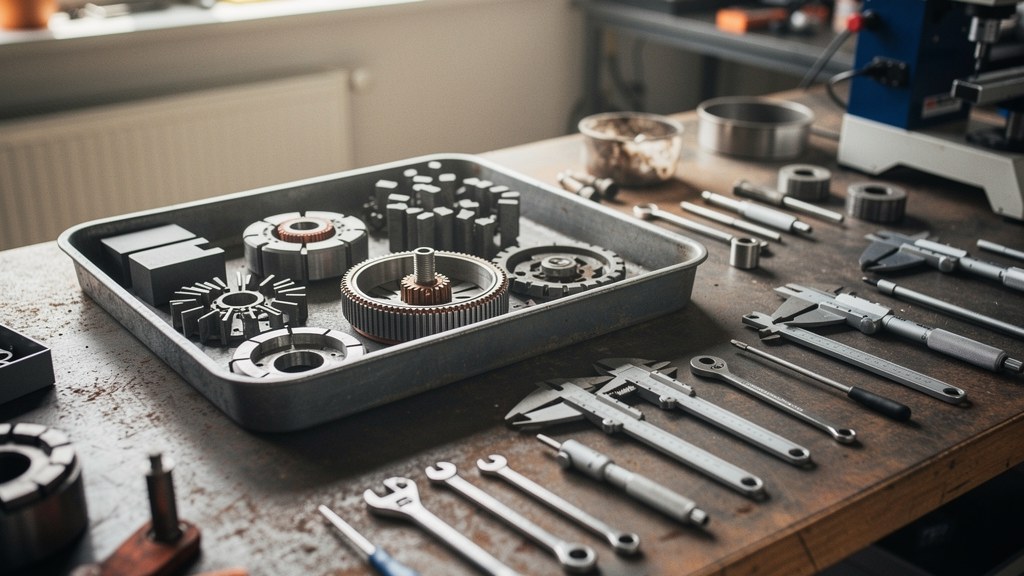
In Noyarey, on the edge of Grenoble, MagREEsource recycles permanent magnets, the kind that power electric motors and wind turbines, into new ones without mining a single gram of new rare-earth ore. The company says its recycling process itself runs without water, and over the whole manufacturing chain it puts the result at 91 percent less CO2 and 86 percent less water than the same magnets made in China. The plant runs an unusual schedule for what it produces: two shifts a day instead of three, simply because there aren’t yet enough trained hands to cover a night shift too.
A recycler that also makes the finished product
Most recycling operations hand off a stream of raw material to someone else’s factory. MagREEsource does not. The company is vertically integrated from recycled scrap all the way to a finished sintered magnet, which makes it a manufacturer that sources its own metal from old magnets rather than from a mine. The Noyarey site, roughly 1,500 square meters after a 400-square-meter expansion completed in 2025, has been fully operational since September 2024 following a pilot phase that started in 2023, and produces about 50 tonnes of high-performance sintered magnets a year with around 35 employees. It is the same logic as the pilot battery line Verkor runs a few kilometers away in Grenoble: prove the process at small scale before building the big plant.
CEO Éric Petit described the expansion in blunt terms: facing rapidly increasing demand, the company decided to add production equipment on its existing site and finish its vertical integration from raw material through to metallization. The magnets that come out are the finished part, ready to go into a motor, not an intermediate powder or alloy sold on to someone else.
Why this exists at all
The company traces its origin to a geopolitical shock rather than a lab breakthrough. In 2011 and 2012, China, which controls the overwhelming majority of global rare-earth production, cut magnet shipments to Japan during a diplomatic dispute, an episode widely cited as proof that rare-earth supply can be weaponized. That crisis revived CNRS research that eventually led Éric Petit to meet Sophie Rivoirard, who headed the relevant CNRS department, around 2018 and 2019. MagREEsource was founded in 2020, built specifically to close the loop: recycle the magnets that already exist in Europe instead of depending on new material shipped from a single dominant supplier. The raw material is already here, in retired motors, hard drives and turbines, the same way Sims Lifecycle pulls working parts and metals out of retired office electronics before anything reaches a shredder.
What comes after the pilot
The company is now scaling that pilot into a full industrial facility, referred to internally as Mag Factory, with French government financing of 25 million euros secured under the France 2030 program. Petit has described a target of 500 tonnes of annual production at start-up in 2027, rising to 1,000 tonnes and roughly 200 direct jobs by 2030. Design and construction of the new site have begun, according to the company’s announcement.
What is already running, on two shifts a day at the gates of Grenoble, is the harder part: proving a magnet recycler can also be the one that ships the finished part.